How Frome’s Collective Action is Reducing Carbon Emissions
As funding for the Green and Healthy Frome’s draws to a close, the quiet revolution it supported has taken root. Together, we’ve created something real, we’re learnt, collaborated, and built a community of action that has shifted how people and organisations show up, daring to imagine new possibilities.
While many services continue, the ideas, knowledge and resources remain woven into our community. As we look ahead to the next chapter, we are undertaking the important task of evaluating the project’s impact and creating toolkits (coming soon to the Green and Healthy Frome website), so others can learn from both its successes and its challenges.
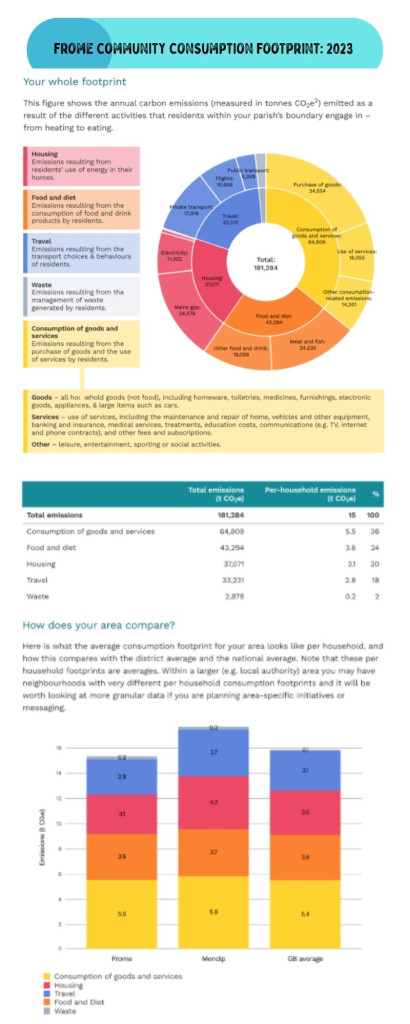
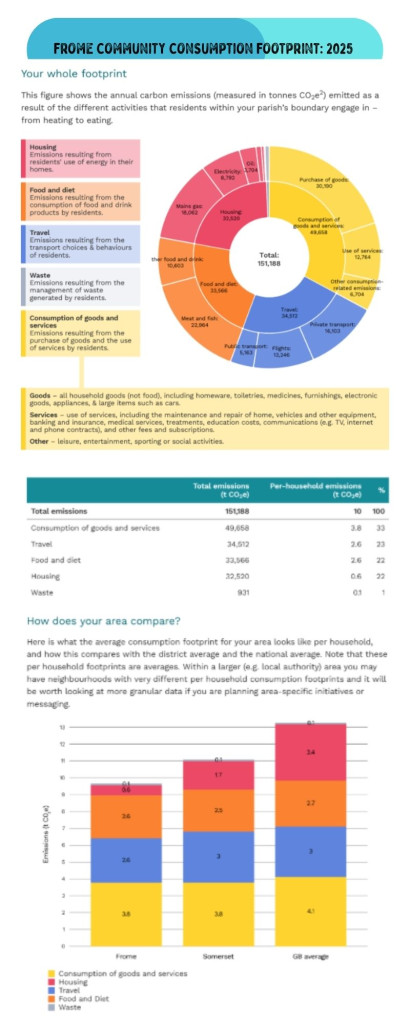
And already, one set of numbers stood out. While collating Frome’s Community Consumption Footprint* – covering Housing (emissions resulting from residents’ energy use at homes), Food and Diet (emissions resulting from what residents eat and drink), Travel (emissions from transport choices & behaviours of residents), Waste: Emissions resulting from the management of waste generated by residents) and Consumption of Goods & Services: (emissions from the purchasing and using of products and services) – we found some encouraging results.
Comparing 2023 with 2026 – total emissions across the town fell from 181,284 to 151,188 tonnes. To put this in perspective (using the EPA’s Greenhouse Gas Equivalencies Calculator) this is the equivalent of 4041 homes’ energy use for one year – and to contextualise this saving using the ‘1000-tonne rule’ (first proposed by Richard Parncutt in 2019, and further developed and solidified in a peer review from over 180 scientific articles supported by publications such as the National Institute of Health and Frontiers) – the ‘1,000-tonne rule’ states that a person is killed every time humanity burns 1,000 tonnes of fossil carbon, so potentially, in three years Frome’s collective behaviour change has prevented approximately 30 future premature deaths caused by climate-related factors.
A Further Breakdown:
💚Consumption of Goods & Services dropped from 64,809 to 49,658 – that equivalent to saving 201 tanker trucks worth of gasoline
💚Waste emissions fell to a third of the 2023 levels
💚Food and diet emissions reduced by over a quarter
While no single project can take credit alone, the data shows that small actions, when taken collectively, do add up. When communities and local organisations dare to act differently – embrace agency and choice, and harness passion and shared responsibility, the impact can be real for both people and the planet.
*The carbon footprints – generated by IMPACT, the Community carbon calculator from our partners the Centre for Sustainable Energy – are modelled on data drawn from more than 30 datasets (some of which are made up of multiple further datasets!). As with all models, decisions have been taken in terms of what data is used, and how the data is ‘cut’ and analysed. The Impact footprints have been developed with the intention that they are as useful as possible, but remember to take them as a guide, not as complete fact.